A weekly review that ends with a number
weekly review10 min read
Run a weekly review in 15 minutes: check the next 10 days, total the hours, and see whether your week fits before you commit.
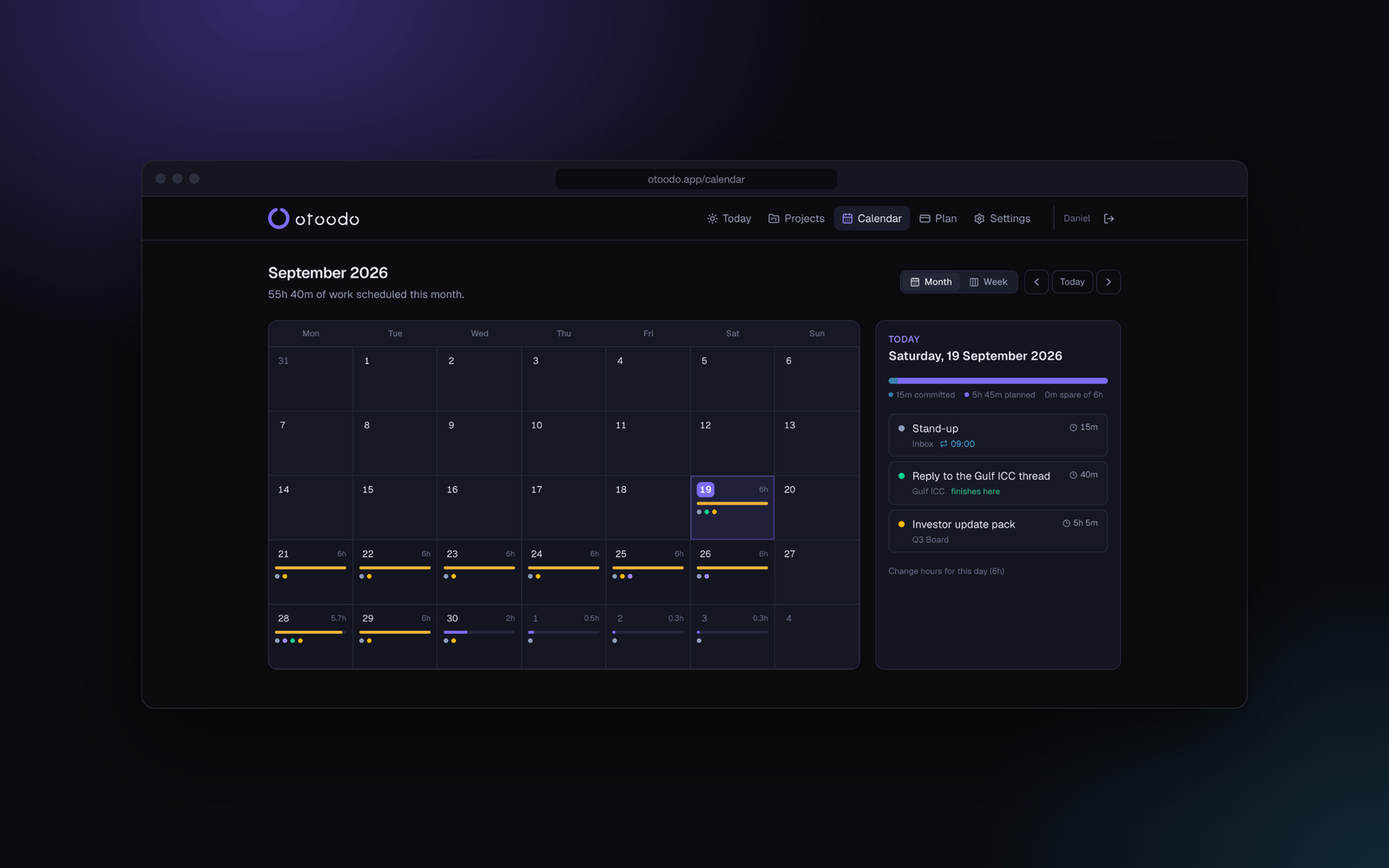
Your weekly review should not become a diary. It should end with a number, because numbers are harder to bluff. If you already know what is due in the next 10 days, how many hours it needs, and how many hours you have, you do not need a longer ritual. You need the arithmetic.
That is the point of a useful weekly review: not reflection for its own sake, but a quick check on whether the week fits. If the sum is too high, you need fewer tasks, more hours, or a later date. There is not a fourth option.
The short version
- Look only at the next 10 days. Anything further out is noise for this review.
- Add up the hours of work due in that window. Estimates can be rough, but they must exist.
- Compare that total with the focused hours you actually have.
- If the work is over capacity, the fix is one of three levers: more hours, a later date, or less work.
A good review can be done in 15 minutes. It should tell you what today must contain, what can wait, and whether a deadline is already impossible in hours. That is a better outcome than a page of notes you never use.
Why the usual weekly review turns into theatre
Most weekly reviews are built for mood, not decisions. You list what happened, what felt hard, what you should probably do next, and then you go back to the same pile of work. The ritual feels responsible. The outcome is still vague.
The problem is not reflection. The problem is drift. A list of tasks can look manageable until you ask how many focused hours they require. Then the polite fiction ends. Three client deadlines, two internal tasks, one half day, and a recurring commitment do not equal “a busy week”. They equal a number.
If your review does not compare work to capacity, it is not a planning review. It is a journal with deadlines.
That is why the best version of this habit is narrow. It asks three questions and stops there:
The three questions that matter
Start with the due window. Ten days is long enough to catch real risk and short enough to avoid fantasy. You do not need the whole quarter. You need the runway that is already in play.
Next, total the work. Use rough estimates if that is all you have. A task does not need forensic accuracy to be useful. It needs to be in the right order of magnitude.
Then total your available hours. Use actual weekday capacity, not the number you wish you had. If Wednesday is a half day, it is a half day. If Friday is already full of meetings, that capacity is gone before the work begins.
Here is the useful rule: the answer is not “I am busy”; the answer is “I am 6 hours short” or “I fit with 2 hours spare.”
A worked example with real numbers
Say it is Monday. You have 6 focused hours on Monday, 6 on Tuesday, 4 on Wednesday, 6 on Thursday, and 3 on Friday. That gives you 25 hours this week. Next week has another 18 hours, but you only care about the next 10 days for this review, so let us say the runway inside that window gives you 33 hours in total.
Now list the work due before the end of that window.
Check the arithmetic, not the mood
This is the line that matters:
- Total work due: 30 hours
- Capacity in the next 10 days: 27 hours
- Shortfall: 3 hours
A shortfall is not a motivational problem. It is a planning problem.
If the number is positive, you need a fix. If the number is negative, you have slack. If the number is close to zero, you need to be careful, because one new task will tilt it.
What to do when the numbers do not fit
The honest answer is usually one of three levers. That is all.
How to keep the review to 15 minutes
Do not turn this into an audit. Fifteen minutes is enough if you do not wander.
Use the same order every time:
- Look at the next 10 days only.
- Pull every task that is due in that window.
- Add the estimates.
- Count your capacity by day.
- Subtract recurring commitments.
- Compare the two totals.
- Decide which lever you need if the numbers do not fit.
A simple script helps if you have a habit of drifting into note-taking.
Where this review is honest, and where it is not
A weekly review based on hours is useful, but it is not magic. Estimates are still estimates. A task that looks like 2 hours on Monday can become 5 hours by Thursday. Research grows teeth. Client comments arrive late. People change their minds.
Some work also does not spread neatly. You cannot always split a legal review, a proposal, or a meeting prep across five days and call it balanced. Some tasks need a block. Some work has to happen on a particular day. The review should allow for that rather than pretending every task is liquid.
And some people should not use a method that depends on rough estimates. If you do not want to estimate even roughly, this style of review will feel like paperwork. It is not built for that. It is built for people who already know that dates have consequences.
A better version of the method is to combine the review with a live view of the week. The explains the arithmetic in plain terms, and makes the difference clear if you are deciding whether a plain list is enough.
A weekly review is only useful if it changes Monday
If the review says you are short, the week must change. Otherwise it was a performance. That can mean moving a task, cutting scope, or telling someone the date needs to shift. It can also mean choosing not to start work that cannot fit.
This is where many people go wrong. They discover the shortfall, nod at it, and then schedule as if the number were a suggestion. By Friday, the result is predictable. The week is crammed, the deadline is still there, and the list is longer than the hours.
A useful weekly review forces a decision early. It does not congratulate you for noticing the problem. It gives you the number so you can act on it.
A simple comparison of review styles
What the week looks like when the maths is visible
When the arithmetic is visible, your plan changes shape. You stop cramming every day equally. You spread work where there is capacity. You leave the impossible items out of the week instead of pretending they will somehow fit after lunch.
That is also why a monthly calendar or a day-by-day list helps only if it shows load, not just dates. A due date without capacity is decoration. A due date with hours beside it is a decision.
The screen above shows the point of the exercise. One day is full. One task is not just late, but 14h 25m beyond the time left. That is not a mood. That is feasibility.
For a slightly fuller view, the post goes deeper into why work spread across the runway beats dumping it into the last few days. If you want the same logic applied to a harder conversation, shows how the number changes the message.
FAQ
How long should a weekly review take?
About 15 minutes is enough if you keep it to the next 10 days and use rough estimates. If it takes longer, you are probably editing tasks instead of checking feasibility. The point is not to build a perfect plan. The point is to know whether the week fits.
Do I need exact estimates for every task?
No. Rough estimates are enough for the arithmetic to be useful. A task that defaults to 1 hour is still better than a task with no number at all. The review works when the totals are close enough to show whether you are short or safe.
What if my week changes after the review?
Then you review again. A capacity check is only useful if it matches the week you are actually in. If a meeting lands, a deadline moves, or a task grows, the numbers change. The method is not fragile. It just refuses to lie for long.
What should I do if I am already over capacity?
Use one of the three levers: more hours, a later date, or less work. If none of those is possible, the shortfall stays. That is still useful to know, because it tells you what cannot be promised without lying.
Can this work for a small team as well as one person?
Yes, if you are planning work against actual hours rather than a vague sense of busyness. The important part is not the number of people. It is whether you can total the capacity and the work in the same window. If you cannot, you will keep discovering the problem late.
A weekly review is supposed to end uncertainty, not generate more of it. If you want a planner that does the arithmetic for you, otoodo shows what the next 10 days contain, how many hours that needs, and whether the week fits. Start at otoodo.app/signup and get fourteen days of Pro free, no card. Fourteen days free, no card.