Four hours of deep work a day is enough. Plan for that
deep work hours per day10 min read
Plan around four deep work hours a day, not eight. See the arithmetic, the shortfall, and why the four-hour week survives while the eight-hour one fails.
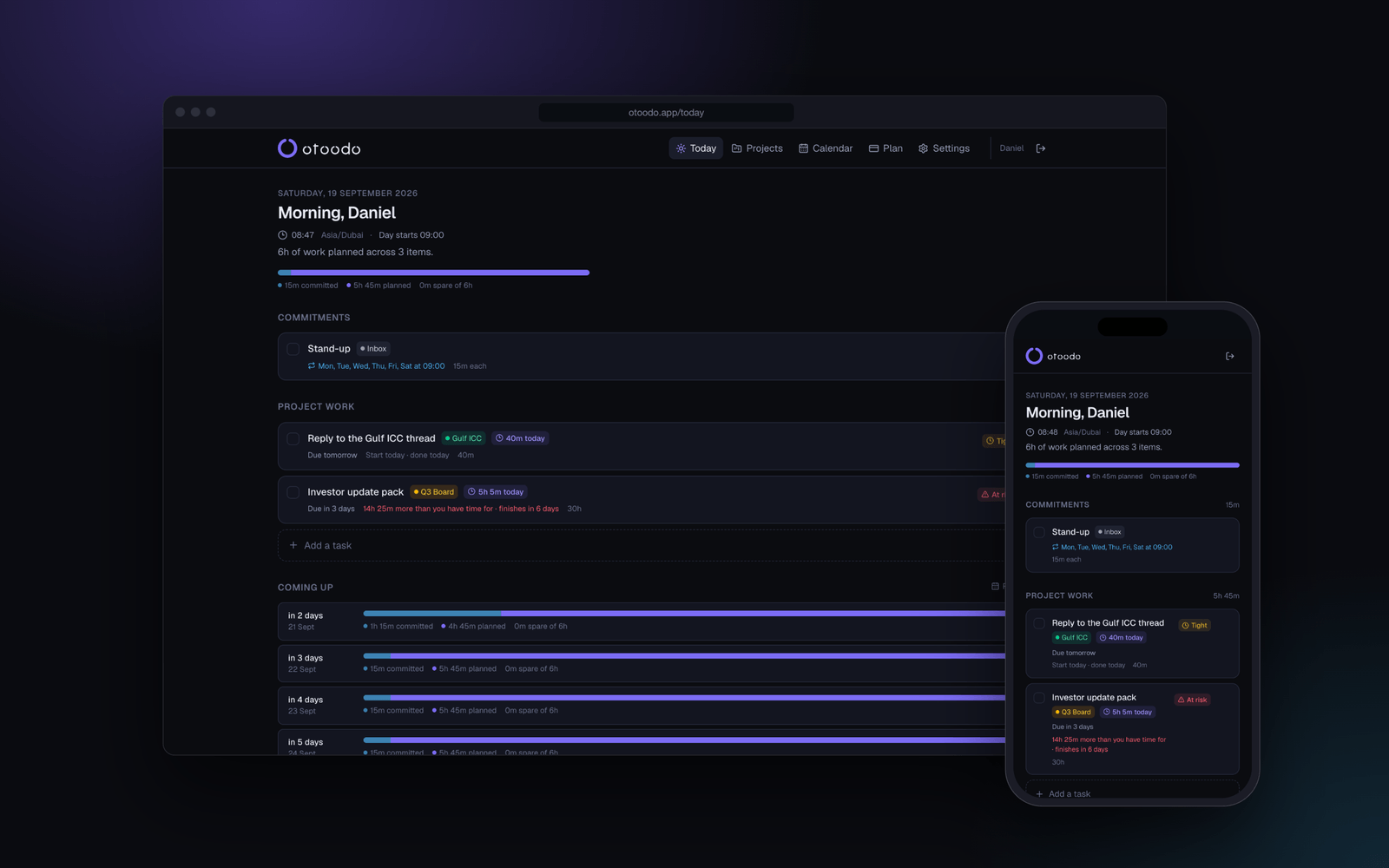
You do not have eight clean hours a day. You have interruptions, email, calls, and work that bleeds into the edges. If you plan as though every weekday holds eight hours of deep work hours per day, your week looks fine on paper and misses in practice.
The better question is not whether you can work eight hours. It is whether you can protect four and a half. For most knowledge work, that is the number that survives the week. The rest is noise, admin, and drift.
The short version
- Plan the week on focused hours, not on a fantasy of eight silent hours a day.
- Four and a half deep work hours per weekday is a stricter and more useful baseline than eight.
- If the work only fits when every day is perfect, the plan is already fragile.
- A week that fits on four and a half hours survives. A week that needs eight usually collapses by Wednesday.
Why eight hours is the wrong default
Eight hours is a shift, not a block of concentration. It is useful for attendance. It is not a useful unit for honest planning.
When you stack deadlines against eight hours a day, you assume that each day is equally productive, equally quiet, and equally available. That is not how work behaves. Some days lose an hour to a client call. Some lose half a day to a review cycle. Some lose 90 minutes to a problem you did not budget for.
The result is familiar. You build a plan that only works in the version of the week where nothing goes wrong. Then the week happens.
A better plan starts from the hours you can actually defend. That may be 4.5 hours a day. It may be 5. It may be less on Tuesdays because the school run exists, or on Fridays because the week is already tired. The point is not to be pessimistic. The point is to be accurate.
If you want a calculator for the arithmetic, use the . It asks a dull question and gives a dull answer. That is usually a good sign.
A worked week at eight hours and at four and a half
Take a simple week. You have five weekdays, a client proposal due on Friday, and three pieces of work that must land before then. The estimates are rough, which is fine. Rough is enough for the arithmetic.
What actually survives the week
The eight-hour version survives only if you are unusually protected. No late call. No handover. No unexpected revision. No one asks for “just a quick look” at 4:20 pm.
The four-and-a-half-hour version survives because it assumes the day contains other things. It leaves room for the tasks that do not look like work until they steal the afternoon.
A week that fits only at eight hours is not planned. It is hoped.
That is the part most planning methods avoid saying plainly. They prefer to speak about priorities, structure, and focus. Fine. But if the arithmetic does not fit, none of those words matter.
This is why deadline-aware planning starts with the hours in the week, not the optimism in your head. A task list can be orderly and still lie. A capacity plan can be ugly and still be true.
Why four and a half hours is a better planning unit
Four and a half hours is not a magic number. It is a practical one.
It is long enough to do real work. It is short enough that the rest of the day can contain the life that refuses to disappear. That makes it easier to protect, and easier to defend when someone tries to put another meeting in the middle of it.
It also makes estimates less theatrical. If a task takes 6 hours, it does not belong in a pretend 2-hour slot. If a task takes 12 hours and there are only 9 usable hours before the deadline, the problem is visible immediately. That is the point.
Here is the trap with eight-hour planning:
Where the method holds, and where it breaks
There is a fair objection here. Not all work spreads neatly. Some tasks need a long, uninterrupted block. Some depend on other people. Some are not yours to apportion into neat daily slices.
That is true. And it is exactly why the plan should be honest.
A simple rule for the week
Use this rule when you are deciding what goes into the calendar and what stays in the list.
If it only fits when every weekday behaves like a silent monastery, it does not fit.
That sounds harsh because it is. But it saves you from a common mistake: confusing available calendar space with available thinking time.
Your calendar can hold eight hours. Your brain cannot always do the same work for eight hours straight. If you plan as though it can, you end up with a smooth-looking week and a rough ending.
This is also where matters. The earlier you spread the load across the runway, the less likely you are to discover a shortfall in the final stretch. That does not remove the deadline. It just stops the deadline from becoming a surprise.
Why a shortfall in hours is better than a vague warning
“Busy” is not a number. “Overloaded” is not a number. “Impossible” is only useful if it comes with hours.
A shortfall in hours gives you the next move. If you are 3 hours short, you can cut scope, move the date, or add capacity. Those are the three levers. There is no fourth.
That is why the capacity spreadsheet you keep rebuilding keeps breaking down. It often tracks work, but not the exact hours left in the week. Without that, you only find out too late that the week never fitted.
When the shortfall is exact, the conversation changes. You are no longer saying, “I feel behind.” You are saying, “This is 3 hours too much for the time left.” That is a cleaner sentence. It is also harder to argue with.
How this changes your planning habit
Once you stop planning on eight hours, the week gets simpler.
You start asking different questions:
- How many focused hours does Monday actually have?
- Which recurring commitments have already taken their share?
- What must today contain so the deadline stays possible?
- Which task is due soonest, not which one feels loudest?
That is a better way to work. It is less flattering. It also survives contact with a real diary.
If you are comparing tools, the same logic applies. A list app can sort your work, but sorting is not the same as capacity. If you want a deeper comparison, see , , or . The question is not which tool is nicer. It is which one tells you when the week does not fit.
What to do when your week is already too full
If the week is already crowded, do not add another heroic plan on top.
First, count the usable hours you actually have. Subtract recurring commitments. Then total the estimated work that must land before the deadline. If the total is larger than the runway, stop pretending it is a scheduling problem. It is a capacity problem.
Then pick one of the three levers:
- More hours. Add capacity with a real working Saturday, a longer day, or a one-off override.
FAQ
Is four and a half hours enough for deep work?
Often, yes. It is enough to make real progress on drafting, analysis, design, coding, and proposal work, especially when the rest of the day contains meetings and admin. The key is that you plan it as the usable part of the day, not as a wish.
What if my work needs longer blocks than that?
Then you plan around those blocks honestly. A task that needs 3 uninterrupted hours should not be split into tiny fragments just because the calendar is full. If your week cannot protect those blocks, the schedule is the problem, not the task.
Should I count lunch as working time?
No. If lunch is in the middle of your day, it is not deep work. If you count it anyway, you only make the plan look better than it is. That is how people end up surprised on Thursday.
What if my team does not use the same planner?
Then keep the plan simple and numeric. Use hours, due dates, and clear ownership. You do not need everyone to live in the same tool to know whether the week fits. You do need the hours to be real.
Is this just another productivity rule?
No. It is a capacity rule. Productivity advice tells you how to work. Capacity arithmetic tells you whether the work fits at all. Those are different problems, and only one of them can save a Friday.
The week that survives is the week you plan to your real capacity
Eight-hour planning is optimistic bookkeeping. Four and a half hours is closer to the truth, and the truth is what keeps the week alive. If you want to check the arithmetic before you promise a date, use the calculator on otoodo’s home page.
otoodo is the deadline-aware planner that works out what today has to contain and shows the shortfall in hours when the week does not fit. Start with 14 days free, no card, then keep the free plan if that is enough.