How to manage multiple projects by splitting each day
how to manage multiple projects10 min read
How to manage multiple projects when one overruns: split the day by hours left, not the week. See the arithmetic, the shortfall, and the fix.
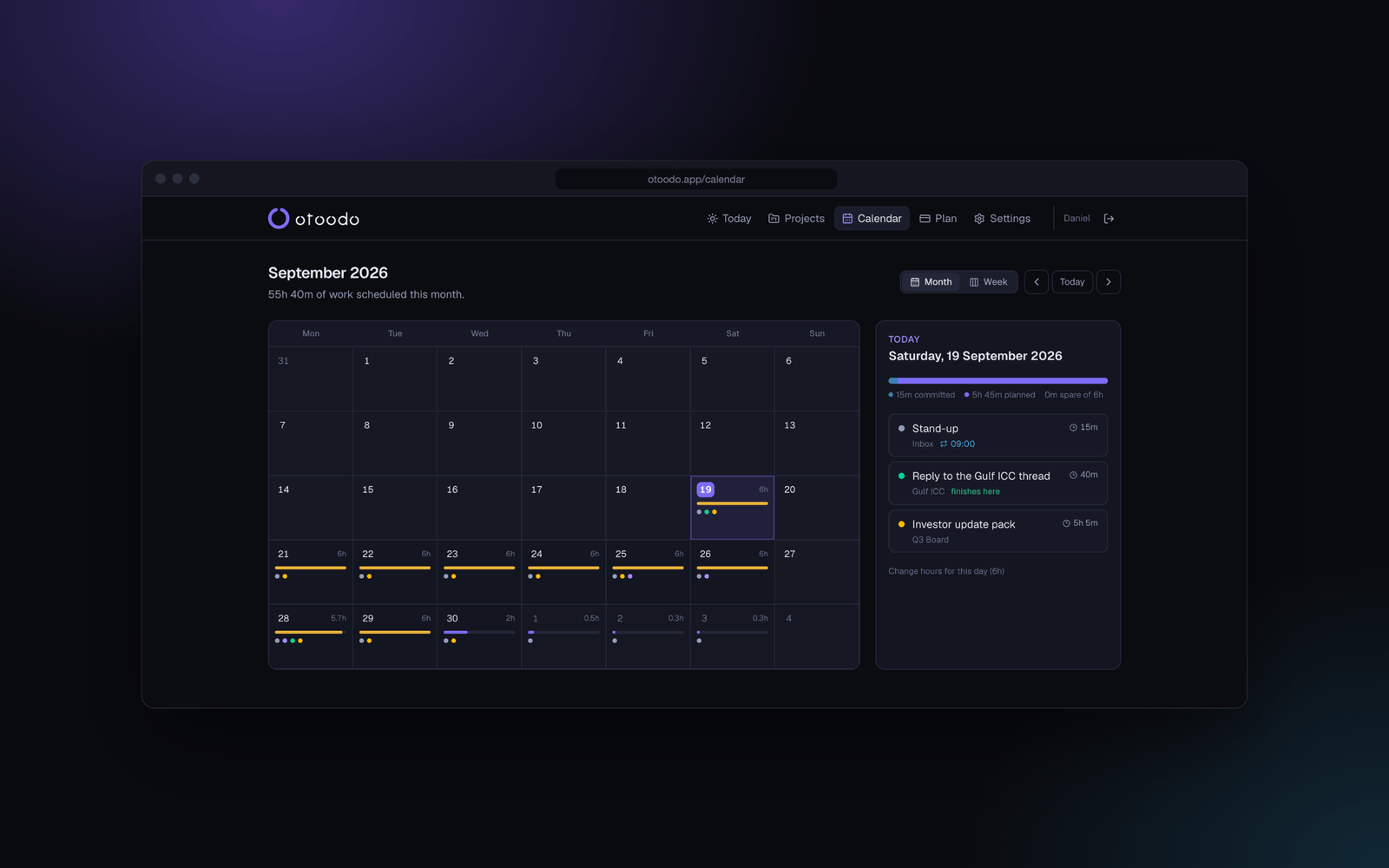
When you are juggling client work, the problem is rarely the list. It is the arithmetic. If you split the week into fixed project days, one overrun breaks the plan and the rest of the week becomes a scramble. If you want to know how to manage multiple projects without kidding yourself, you need to split the day by hours left, not the week by instinct.
That means you stop asking, “Which project owns Tuesday?” and start asking, “How many focused hours does Tuesday actually hold after recurring commitments, and what must each project get from that runway?” Once you do that, the plan survives overruns because it is sized to capacity, not to hope.
The short version
- A weekly project-day model breaks as soon as one client takes longer than planned.
- A daily share model works better because it uses the hours left in each day, then spreads work proportionally.
- If a task is 10 hours and there are 10 working days left, it asks for about 1 hour a day, not a block of “someday”.
- If the numbers do not fit, the honest answer is a shortfall in hours, not a mood.
The point is not to make your week prettier. It is to make it measurable. You either have enough hours, or you do not.
Why dedicating whole days to one client usually fails
The weekly split looks tidy on paper. Monday for Client A, Tuesday for Client B, Wednesday for internal work. Then Client A sends comments late, or a proposal takes longer than expected, or a handoff lands in the middle of the day. The whole arrangement collapses because the unit is too large.
That is the usual failure mode for solo operators and small studios. You are not dealing with one project at a time. You are dealing with a queue of deadlines that all think they are the current one.
A day-based share is less glamorous and more useful. It assumes every project is competing for the same finite resource: focused hours. If you only have 6 workable hours after meetings and recurring commitments, that is what the day contains, whether your plan likes it or not.
The arithmetic that keeps the week honest
The basic rule is simple. Take the hours left before the deadline, take the work left to do, and divide the work across the runway. A 10-hour task with 10 working days left asks for about 1 hour per day. If only 5 days remain, the daily share doubles.
That is why daily planning holds where weekly blocking fails. The daily share adjusts when the runway changes. A day overruns, and the next day picks up the weight automatically instead of pretending Thursday is still the same shape as Monday.
Here is a worked example with real numbers.
Suppose you have 3 client projects open on a Monday:
What proportional spreading does that fixed days cannot
Proportional spreading is dull, which is why it works. Instead of giving each project a ceremonial block, you give each one its share of the available runway. A larger task gets more hours per day. A smaller task gets fewer. Nothing gets crammed into the last two days unless the math forces it there.
That matters because the nearest deadline wins. If Client B is due in 4 days and Client C is due in 5, Client B naturally takes more of today’s usable hours. You do not need to “feel” which one matters more. The dates decide.
There is also a floor. Nothing gets sliced under 30 minutes, because sub-30-minute fragments are usually just context switching with better branding. And a task never misses the minimum it needs today to stay possible. If the plan is already tight, the system protects the hours that keep the deadline alive.
For readers who prefer to see the shape of the day rather than trust a paragraph, the home calculator at does the same arithmetic with hours a day, days to the deadline, and total work.
A day that overruns should not break the week
The old model says Monday belongs to Project A. When Monday goes wrong, Tuesday becomes a rescue operation. That is how solo operators end up “catching up” all week and still missing something on Friday.
A daily share model does not care that Monday was messy. It asks a more useful question: how many hours are left today, and how should those hours be split across the deadlines that still need to land?
The practical effect is plain:
- If a task is ahead, it still gets some attention, but not more than the runway justifies.
- If a task falls behind, tomorrow’s share increases because the runway shrank.
- If there is no way for the week to fit, you find out in hours, not in apologies.
That last point is the one people tend to resist. The arithmetic does not flatter your optimism. It tells you the shortfall.
A worked daily plan for three projects
Here is a more concrete day. Imagine you have 6 focused hours available on Tuesday after fixed commitments. You have three project tasks to fit into that day:
How to manage multiple projects when estimates are rough
Most readers do not have perfect estimates, and they should not pretend to. Rough numbers are enough. A task can default to 1 hour, then become more precise when you know more.
That is good enough because the planner is not trying to write your work for you. It is trying to prevent a false week. If the estimate is rough but the total still exceeds the available hours, you have learned something useful. If it fits, you have a workable shape for the day.
The honest weakness here is also obvious. Some work is not splittable. A client call, a live workshop, a proofing session, a hard handoff deadline: these do not divide neatly across 5 days. For those tasks, a proportional plan is still useful, but it does not magic away the fact that the work must happen whole.
A sceptical approach is best:
The methods that help, and where they break
There are plenty of good productivity methods. The problem is not that they are useless. The problem is that many of them stop at priority and never touch capacity.
When the arithmetic says no, say no in numbers
The most useful output is not a colourful board. It is a number you can say out loud.
If a client asks whether you can still meet Friday, and the plan says you are 8 hours short, that is a cleaner answer than “I will try.” It gives you the basis for the three levers. You can add hours, move the date, or reduce the scope. You cannot pretend the extra 8 hours exist.
That sounds harsh. It is also kinder than discovering the gap on Thursday evening.
A simple script helps:
I have checked the remaining work against the hours left. We are 8 hours short for the current date. If we keep the scope, the date has to move. If the date stays, 8 hours of work need to come out.
That is not drama. It is arithmetic with a subject line.
Why this is better than rebuilding a weekly plan
A weekly plan often asks you to decide too much at once. You choose project days, then protect them, then defend them, then repair them after the first delay. By Wednesday, the plan has become a memory exercise.
A daily share plan is less theatrical. It only asks what each day can hold, after the fixed commitments come off the top. Then it allocates work proportionally across the days that remain. The nearer deadline gets a larger share. The longer runway gets a smaller one. That is all.
You can still think in projects. You just stop pretending each project owns a whole day when the day is already spoken for. That change is why the plan survives overruns.
It also helps with the small stuff that ruins weeks. A half-day, a school run, a long call, a working Saturday, a holiday, a day when you are simply not at full capacity. A daily model sees those changes immediately. A weekly block often notices them after the damage is done.
FAQ
How do I manage multiple projects when everything is urgent?
Start with hours, not adjectives. List each project, estimate the remaining work, and check how many focused hours the days before each deadline actually contain. If the numbers do not fit, the work is not “busy”; it is over capacity.
Should I split my week by client or by deadline?
By deadline, but at the day level rather than the week level. A weekly client day looks neat until one project overruns and the rest of the week gets bent around it. A daily deadline share keeps the plan attached to the runway.
What if I do not know how long the work will take?
Use a rough estimate. A rough number is better than a blank. If a task defaults to 1 hour and the plan still does not fit, you have already learned something useful about the week.
What if a task cannot be split across days?
Treat it as a whole. Not every task spreads neatly, and pretending otherwise is how people end up with impossible calendars. The arithmetic still helps because it shows how much room the whole task needs.
How do I tell a client the date is impossible?
Use the shortfall. Do not say you are “swamped”. Say the remaining work exceeds the available hours by a specific amount, and offer the three levers: more hours, a later date, or less work.
The simple rule to keep
If you want the week to survive reality, stop dedicating whole days to one project and start sharing each day by hours left. The plan gets less dramatic and more accurate, which is usually the point.
If you want the same arithmetic on your own work, start at otoodo and then check the pricing page when you want the numbers in front of you. The product is a deadline-aware task planner that shows what today has to contain, and it works from a phone browser too.
Fourteen days free, no card. Start at otoodo.