Capacity planning for freelancers: the four numbers that matter
capacity planning for freelancers10 min read
Capacity planning for freelancers gets simple when you track four numbers: focused hours, recurring hours, booked work, and the crossing date.
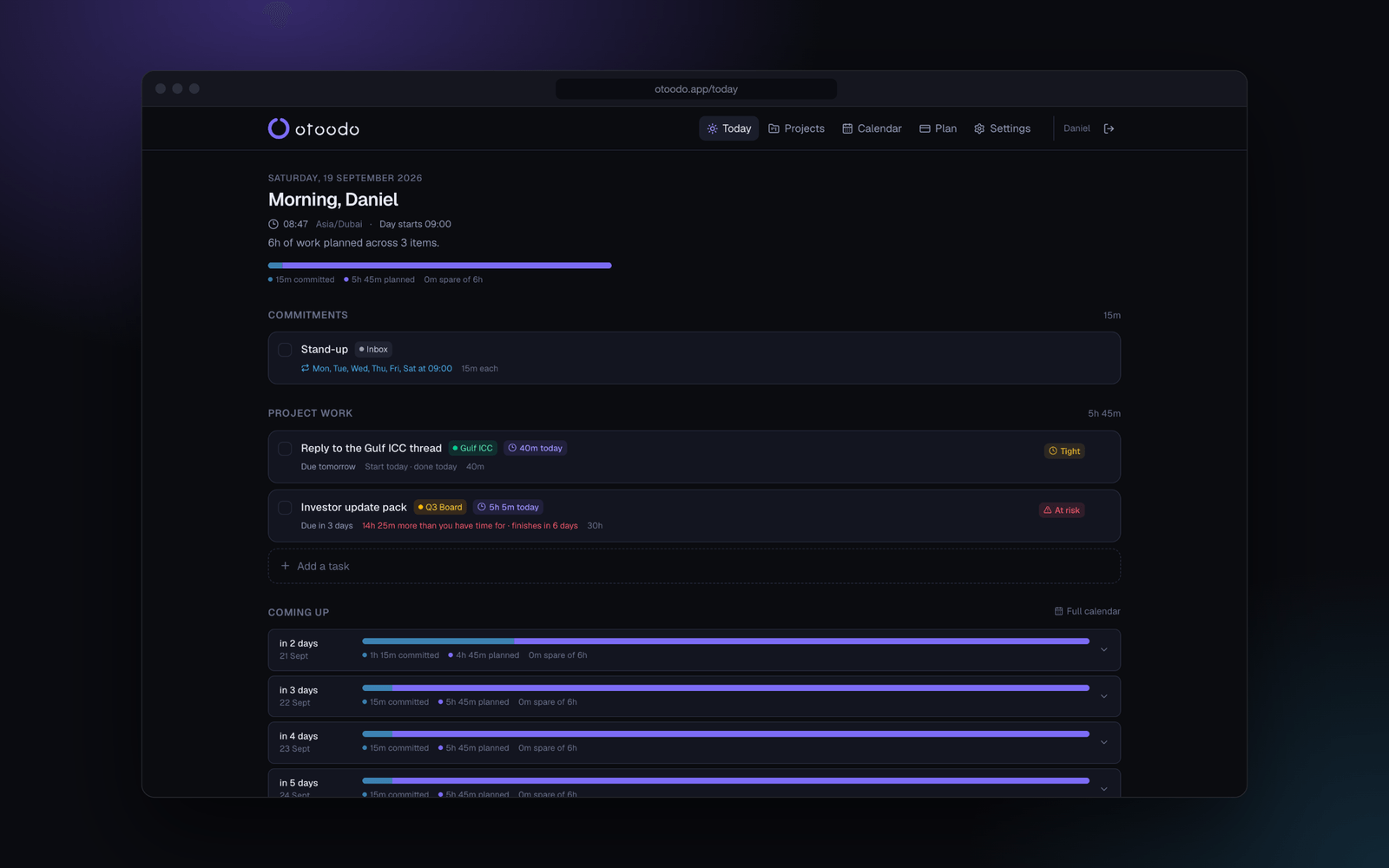
The short version
- Capacity planning for freelancers starts with one number you can defend: how many focused hours each weekday actually holds.
- Then subtract the hours already spoken for. Recurring calls, admin, school runs and client check-ins are not “background”. They are booked work.
- Compare that remaining capacity with the hours you have promised. When the two lines cross, the week stops being theoretical.
- If the work does not fit, the fix is usually one of three levers: more hours, a later date, or less work.
You do not need a larger productivity system. You need four numbers and enough honesty to use them.
Capacity planning for freelancers starts with hours, not intention
Most freelancers do not lose the week because they are lazy. They lose it because they plan with hope instead of capacity. A task list can sort work, but it does not know whether Wednesday has 5 focused hours or 2, or whether Thursday is already half gone before the real work starts.
That is why capacity planning for freelancers is arithmetic before it is organisation. The first number is the focused hours available each weekday. Not the hours in the diary. The hours you can actually use after breaks, calls, school pick-up, and whatever else keeps the day from being fantasy.
Once you have that number, the rest becomes measurable. You can tell whether the week fits. You can tell a client whether a date is possible. You can stop pretending every day is the same.
If you want the same logic in a simple calculator, the home page has one at . If you want the fuller explanation of what “possible” means, covers the same idea from the other side.
The four numbers you need
The four numbers are not complicated. They are only inconvenient.
How to count focused hours without flattering yourself
Focused hours are the hours left after the day becomes real. That means lunch, school runs, client calls, the inevitable twenty minutes you spend reopening old tabs, and the task-switching tax that always arrives whether you invited it or not.
For some freelancers, this is 6 hours on a good day. For others, it is 4. The number matters less than the honesty.
A simple rule is to set weekday hours by reality, not ambition:
- Monday: 5 focused hours
- Tuesday: 6 focused hours
- Wednesday: 6 focused hours
The worked example: when the lines cross
Here is a plain example with real numbers. Assume a freelancer has the following capacity for the next 5 working days:
What happens after the crossing date
A crossing date is useful because it forces a decision. There are only three levers, and they are usually the only honest ones.
Estimate the work, then spread it instead of cramming it
One reason freelancers get trapped is that they treat every task as if it can be left alone until the last possible day. That is how a week becomes a warehouse fire on Thursday.
A better approach is to spread work across the runway. If a 10-hour task has 10 working days left, it does not need a heroic blast at the end. It needs roughly an hour a day, with the amount adjusted to the actual capacity of those days.
The arithmetic gets sharper when you add the rule that work should finish 15% of the runway early, capped at 3 days. That means the plan does not wait until the last minute and then act surprised when the last minute arrives.
This does not mean every task slices neatly into tiny pieces. It does not. Some work genuinely needs a block of time. Some days only allow 30-minute slices or 1-hour slices once the real commitments are removed. That is normal.
A practical rule is to schedule what must happen today to keep the task possible, then let the rest fall where the capacity allows. The point is not aesthetic balance. The point is feasibility.
A simple capacity planning template for freelancers
You do not need a spreadsheet full of macros. You need a template you will actually keep updated.
Use this structure for each week:
- Write your focused hours per weekday.
- Subtract recurring commitments.
- List every booked task with an estimate and due date.
- Add the estimates and compare them with the remaining capacity.
- Mark the crossing date when demand overtakes supply.
That is enough for most solo work.
A second table helps when you are juggling several client dates.
Where capacity planning breaks, honestly
Capacity planning for freelancers is useful, but it is not magic. It breaks when estimates are fantasy. It also breaks when a task cannot be spread at all, such as a meeting, a live handover or a one-shot recording session.
It also breaks if your week changes constantly and you never update the numbers. A capacity model is only as useful as the week you feed it. If you keep moving the goalposts and never recalculate, the answer will be tidy and wrong.
Some people should use something else. If you live in a world of fixed appointments and very little discretionary work, a simple calendar may be enough. If you never estimate anything and refuse to start, no planner can rescue you from that.
The honest weakness is the same as the strength: the method asks for numbers. Some people prefer vibes. Vibes are cheaper until the deadline arrives.
For comparison shopping, and are the clearest comparisons on the site for people who want to see where arithmetic starts and a general workspace stops.
Capacity planning for freelancers in a real week
The phrase sounds formal, but the use case is plain. You have 3 to 8 active deadlines, not 40. You want to know on Monday whether the week fits. You want a number you can send to a client when it does not.
That is why the crossing date matters more than raw task lists. It gives you a line you can defend. It tells you when the booked work becomes too much for the hours you actually have.
A freelancer who checks that number early can do something with it. A freelancer who checks it on Friday usually gets a lesson instead.
Capacity planning for freelancers is not about being more disciplined in the abstract. It is about replacing guesswork with arithmetic before the week turns around and bites.
FAQ
How many hours should a freelancer count as capacity?
Count the hours you can truly use for focused work, not the hours that exist in theory. If you have school runs, recurring calls or other fixed commitments, remove them first. The right number is the one that still holds on an ordinary week, not the one that flatters you on a good day.
What if every task estimate feels wrong?
Use rough estimates anyway. They do not need to be perfect to be useful. A planner only needs enough accuracy to show whether the week fits, and a rough 2-hour task is far better than an unspoken 2-hour task pretending to be free.
Do recurring meetings count as booked work?
Yes. If a call happens every Tuesday, it is booked work. It removes capacity before you assign anything else. Treating it as optional is how a week becomes overcommitted while still looking tidy on paper.
What is the crossing date in capacity planning?
It is the point where your booked hours exceed your remaining capacity. Before that date, the week still fits. After it, the plan is short on hours. That is the moment when you decide whether to add hours, move the date or cut work.
Is this the same as time blocking?
Not quite. Time blocking assigns work into the calendar. Capacity planning checks whether the work can fit before you block anything. You can use both, but the arithmetic should come first or the blocks may be fiction.
The simple conclusion
If you know your focused hours, your recurring commitments, your booked work and the date the lines cross, you can stop pretending the week is larger than it is. That is the whole trick. The numbers may be rude, but they are kinder than a Friday surprise.
otoodo turns that arithmetic into a planner that says what today has to contain and when a deadline is already impossible. Start with fourteen days free, no card and let the week be counted instead of guessed.