Put time estimates on every task and your list starts telling the truth
to-do list with time estimates9 min read
A to-do list with time estimates shows what fits, what slips, and when a deadline is already short by hours, not guesswork.
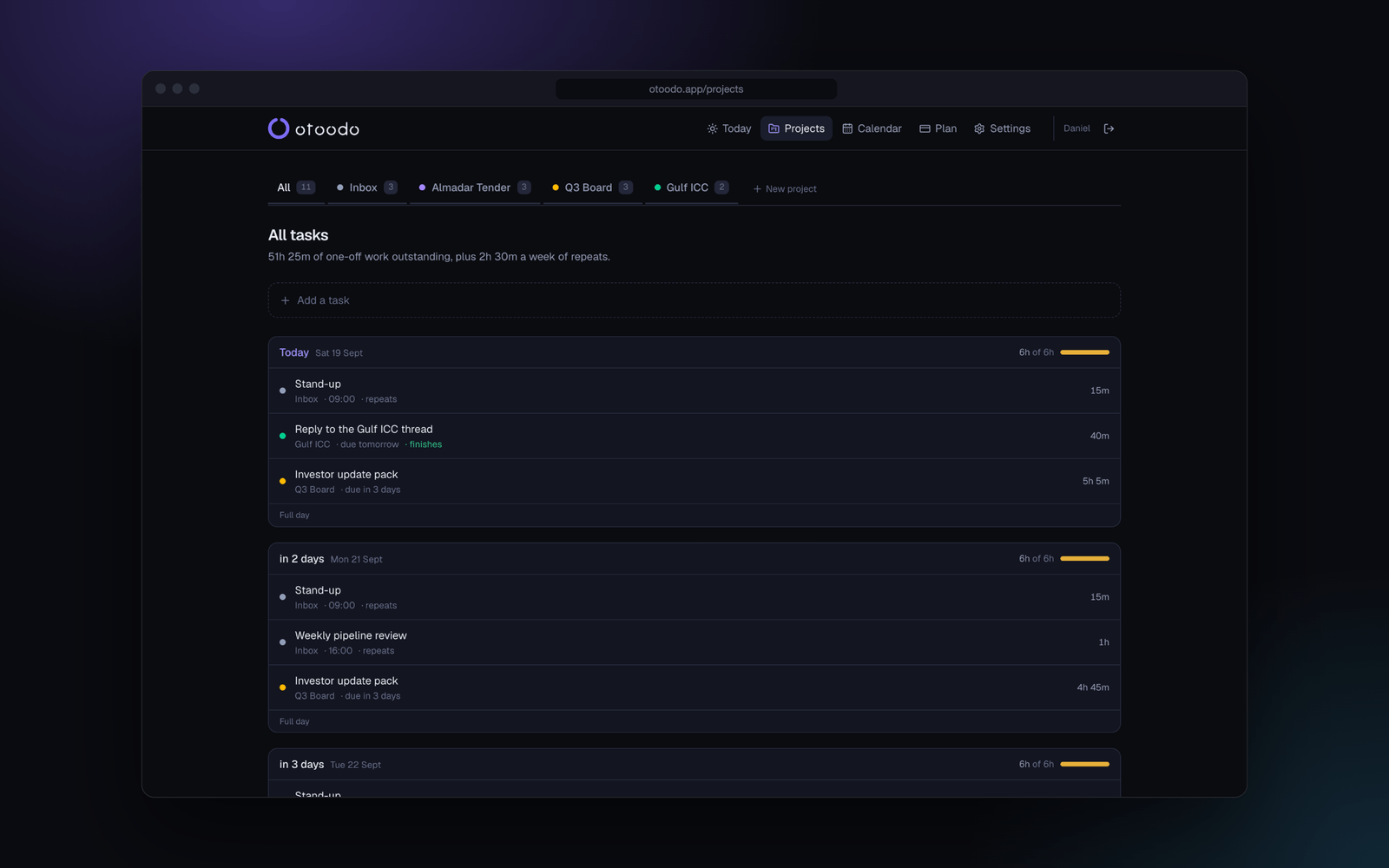
A list without time estimates is a wish list. It may be tidy. It may be complete. It does not tell you whether the week fits.
A to-do list with time estimates changes that. Once every item has minutes or hours attached, the numbers start to sum. You can see overload before Friday, not after it. You can also see which deadline is already short by 6 hours, which is the sort of fact a client can use.
The short version
- If every task has an estimate, your list stops being a queue and starts being arithmetic.
- The useful question is not “what is urgent”, but “how many focused hours do I actually have before this due date”.
- Estimates do not need to be perfect. Rough is enough to expose a shortfall.
- Once the numbers are visible, you can spread work across the runway instead of cramming it into the last 2 days.
Why estimates change the meaning of a list
A plain list tells you what exists. It does not tell you what fits. That is why people keep rebuilding spreadsheets on Sunday night and still end up surprised on Thursday.
When you add time estimates, each task becomes a claim on the week. Ten tasks are no longer ten lines. They are 14 hours, or 31 hours, or 9 half-hours that compete with meetings, admin, and the odd interruption that always arrives anyway.
That matters because capacity is not vague. Your week has a number of focused hours in it. If your work week holds 22 hours and the items on the page total 29 hours, the list is already overdrawn. No amount of colour coding changes that.
This is why a to-do list with time estimates is different from an ordinary list. It does not just sort the work. It lets you count it.
The arithmetic that makes the list honest
The first useful habit is simple. Put a rough estimate on every task, even the small ones. A 15-minute reply is still 15 minutes. A slide deck that takes half a day is still half a day.
You do not need theatre. You need enough accuracy to prevent fantasy. If a task is unclear, start with a default such as 1 hour and refine it later. A rough estimate that is slightly wrong is still far better than no estimate at all.
Here is the basic logic:
What happens when deadlines are close
The real value of estimates shows up when the due date is not generous. Work does not spread evenly across the calendar unless you make it.
Imagine you have 4 working days left before a deadline and 12 hours of work to do. That is 3 hours a day. If you wait until the last 2 days, the same work becomes 6 hours a day, which is where bad decisions are born.
A better plan spreads the work in proportion to the runway. That means a 10-hour task with 10 working days left asks for about 1 hour a day. It does not ask for 10 hours on the last day, because that would be the sort of planning that flatters nobody.
A second rule matters here. Nothing should be sliced under 30 minutes. If a task is too small to survive that rule, it probably belongs with another item. A schedule full of 12-minute fragments looks disciplined and behaves like a mess.
A worked example you can check
Here is a simple week. You have 5 working days. Your weekday capacity is 4 focused hours a day after recurring commitments. The tasks due this week are as follows:
Why the numbers are useful even when they are rough
People often object that estimates are wrong. They are. The objection is true and not very helpful.
A rough estimate is enough to reveal the shape of the week. If you think a task is 45 minutes and it turns out to be 75, the error matters. But the list was still more honest than a page that treated both tasks as equal lines.
The useful habit is to estimate consistently, not perfectly. Over time, you learn where you are optimistic. You also learn which kinds of work are never one hour, despite your best wishes.
The estimate is not a promise. It is a boundary. It tells you what this work costs in focused hours, and therefore what else must give way.
When the list says the deadline is impossible
Sometimes the arithmetic is ugly. That is not a failure of the method. It is the method doing its job.
If a task needs 18 hours and there are only 12 focused hours left before the due date, the shortfall is 6 hours. That is the number that matters. It tells you the gap between what you have and what the deadline asks for.
Once you know the shortfall, you have only three levers:
- More hours.
- A later date.
- Less work.
Anything else is decoration.
That is also why a time-estimated list helps with conversations. You are not saying, “I feel overloaded.” You are saying, “This job is 6 hours short against the time left.” Those are different sentences. One is a mood. The other can be used.
Where this method holds, and where it breaks
A time-estimated list is not a cure for every kind of work. Some jobs cannot be chopped into neat blocks. Some estimates are too fuzzy to carry much weight. Some people would rather track work in a calendar than in a list.
That is fine. The method still has a clear boundary.
How this compares with a plain priority list
A priority list answers one question: what should I do first. A time-estimated list answers a better one: what can I actually finish before the deadline.
The habit that makes estimates work in real life
The habit is not “estimate once and move on”. It is “estimate, compare, then adjust”.
Start by entering every task with a rough duration. Then compare the total with the hours available before the due date. If the list fits, spread the work across the runway instead of dumping it into the last day. If it does not fit, decide which lever you are pulling.
The point is to find out on Monday, not on Friday. That is what the arithmetic buys you. Not inspiration. Not false calm. Just an accurate answer about the week.
If you want a way to do that without rebuilding the numbers every time the week changes, the same arithmetic is shown on the home page at the calculator, and the broader method is set out in .
FAQ
Do I need exact estimates for every task?
No. Exact estimates are useful when you already know the work well, but rough estimates are enough for most planning. The goal is to expose fit and overload, not to produce a perfect timesheet.
What if a task takes less than 30 minutes?
It can still be estimated. The useful rule is that the schedule should not be chopped into tiny fragments. If the work keeps breaking into 10-minute pieces, it usually belongs beside something else or in a larger block.
What if my estimates are often wrong?
Then your list is still more useful than a list with no time at all. Wrong estimates become a pattern quickly. Once you notice that pattern, you can adjust future numbers and stop pretending the week has more room than it does.
Should I estimate meetings, admin, and calls too?
Yes, if they consume focused hours. A week full of “quick calls” is usually not quick. If it takes time, it belongs in the arithmetic, because time spent on one thing is time not spent on another.
What should I do when the list is already over capacity?
Do not add more colour. Pick one of the three levers: more hours, a later date, or less work. If none of those moves are available, the list is not the problem. The deadline is.
A to-do list with time estimates is the quickest way to see whether your week fits before the week starts. If you want the whole planner, not just the arithmetic, otoodo gives you the same deadline logic in a working product.
Start with 14 days of Pro on signup, no card, then keep the free plan if you want the whole planner for one person and 3 projects. Fourteen days free, no card.